by First American State Bank | Jun 19, 2023 | Colorado Expression Magazine, News
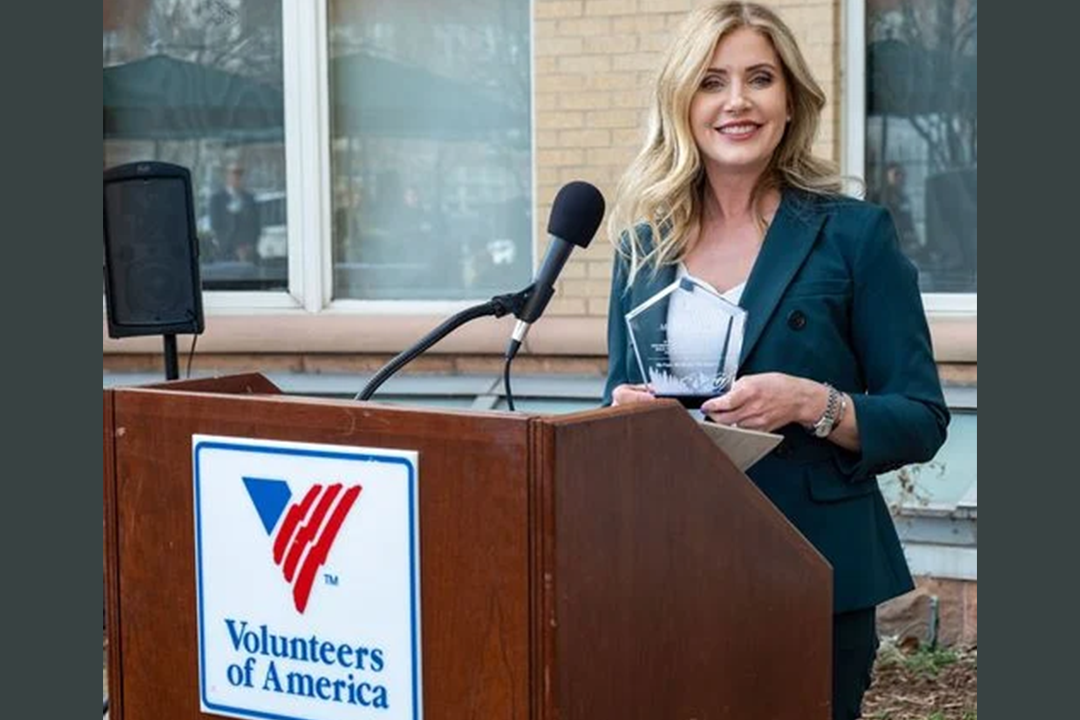
Michelle Gruber receives VOA Colorado’s 2023 Special Friend Award
Here at Colorado Expression we have so many advertisers and friends that are involved in making this community great and this is no exception.
Michelle Gruber VP at First American State Bank in Greenwood Village was honored recently at Volunteers of America for her 10th year anniversary of the Village Toy Drive this December. Michelle has selflessly dedicated herself to making sure the Toy Drive works seamlessly and is the recipient of this years VOA Colorado’s 2023 Special Friend.
Congratulations Michelle!
by First American State Bank | May 9, 2023 | News
Overview
Do you hate passwords? Are you tired of constantly logging into new websites or can’t remember all of your complex passwords? Frustrated by having to generate new passwords for new accounts or having to change old passwords for existing accounts? We have good news for you. There is a solution called biometrics that helps make cybersecurity easier for you. Below we explain what biometrics are, how they make your life simpler and why you will start seeing more of them.
First, Why Password?
Passwords are part of something called authentication, the process of proving who you are. There have typically been two things you can provide to prove your identity: something you know (like your passwords) and something you have (like an ATM card or your mobile device). Traditionally authentication has been done with passwords. Passwords were first adopted as it was one of the easiest authentication solutions to deploy. However, over the years our lives have become far more complicated with far more accounts than anyone ever expected. It is quite common for a person to have over 100 passwords in their work and personal life.
In addition, cyber attackers have become quite good at guessing, stealing or cracking passwords.
This is why you see so many rules about passwords, such as making them long (so they are hard to guess) and using a unique password for every account (so if one of your accounts is hacked, your other accounts are still safe). The problem with all of the password requirements is they make being cybersecure more difficult. Password managers dramatically help as they securely remember all of your passwords and log you into websites for you, but is there a better way? This is where biometrics can help by providing a third thing to prove your identity – something you are.
Biometrics
Like passwords, biometrics are another way to prove who you are. The difference is instead of having to remember something (like your passwords) you use an element of who you are to prove your identity, such as using your fingerprint to gain access to your phone. Biometrics are much simpler as you don’t have to remember or type anything, you just authenticate using who you are. There are many different types of biometric such as your voice, how you walk, or your iris prints. However, fingerprints and facial recognition are the two most common, especially for mobile devices. While biometrics have a tremendous number of advantages, they also have some disadvantages, one of the biggest being if your fingerprint or face is copied by cyber attackers, you cannot change them.
Passkeys
Over the coming months and years, you should start seeing biometrics replacing passwords with a new technology called Passkeys. This technology is being adopted by Microsoft, Apple and Google and you should soon see it being adopted at more and more websites over time. Passkeys replace passwords by allowing you to prove who you are by simply using biometrics combined with your mobile device. When you create an account at a website (such as Google or Apple) instead of creating a password you register your mobile device. Moving forward you log into that website by authenticating with your mobile device using biometrics, such as your fingerprint or facial recognition. The website trusts your mobile device, and your mobile device confirms it’s you using biometrics. In addition, your biometric data (fingerprint or face) is not sent to any website. Instead, your biometrics is securely stored locally on your device. It’s just used to unlock the “Passkey”, a unique key, created for each site, which your device sends to the site while protecting your biometric data. While no solution is perfect, biometrics and solutions like Passkeys can help keep you secure while simplifying security.
by First American State Bank | May 1, 2023 | Cyber Security News, News
From: SANS Security Awareness
Artificial Intelligence (AI) describes systems programmed to think and respond like humans. In fact, we asked the AI solution ChatGPT that very question and got this response.
What is Artificial Intelligence?
Artificial intelligence (AI) refers to the simulation of human intelligence in machines that are programmed to think and learn like humans. It involves the development of algorithms and computer programs that can perform tasks that typically require human intelligence, such as recognizing speech, understanding natural language, making decisions, and playing games. There are several types of AI, including rule-based AI, expert systems, and machine learning.
What makes AI so powerful is it can simulate the intelligence and reasoning capability of the human mind, but it can analyze exponentially far more information than any human and do it exponentially faster.
The concept of AI is not new. Originally covered in science fiction novels, AI is something that has been in development for decades. The reason you are hearing so much about it now is that for the first time, anyone has the opportunity to interact with and see the true functionality of AI.
ChatGPT, an online-powered AI chat bot, is one of the first publicly available solutions that is able to respond like a real human, passing something called the Turing Test. This test determines a machine’s ability to exhibit intelligent behavior by having a real human interact with the machine through a text- based chat channel. If the human could not tell whether they were interacting with a machine or person, the machine is said to have passed the test. AI solutions today are the first publicly available that do just that.
However, online conversations are just the beginning of what AI can do. There are now AI solutions that can create a video of a person teaching a class in any language, analyze health records and quickly determine who most likely has cancer, create news articles or essays on the topic of your choice, generate images for children’s books, or create code for new computer programs. While AI is not necessarily something to be feared, there are some dangers of which to be aware.
Dangers of Artificial Intelligence
- Recreating You: AI solutions can take a recording of a person’s voice – your voice – and then use it to create real-time audio that sounds just like you, saying whatever it wants to impersonate you. So, a cyber attacker could record a phone voice message that sounds like you, tricking your coworkers, your bank, or a family member into thinking you called and asked them to take an action. AI can also do this with pictures or video. Sometimes called Deep Fakes, an AI solution can take an existing picture or video of you and use it to recreate entirely new pictures or videos (including your voice) appearing to show you doing things that you never did.
- Wrong Answers: As for the data or answers AI provides, the solutions can be wrong. AI often uses public information from the Internet, and its answers can be influenced by the biases of its developers. While typical search engines are designed to provide you the “best” or most correct answer to your queries, solutions like AI may be designed to give you the most human- like answer. Which is better depends on what you are attempting to achieve.
- Not All Equal: With AI becoming the latest hot technology, there are literally hundreds of startup companies now offering different AI services. Many of these want your information or credit card for a trial. Be careful – not all AI services are trustworthy. Do your research before signing up and using an AI service.
- Your Privacy: Whenever using or interacting with an AI system, such as when chatting online with ChatGPT, be aware that any information you enter into the system can not only be processed by it but also retained and used to give answers to others. This means if you enter any personal information about yourself or any confidential information from work, that information will be stored and potentially shared with or sold to others. Do not share or enter any information that you consider sensitive, personal, or is confidential at work.
The Future of AI
Artificial Intelligence is still very much in its infancy, similar to where the Internet was twenty to thirty years ago. While we can expect rapid evolution and adoption of AI, it’s very difficult to predict what its impact will be. Just be aware that these capabilities are out there, and when using AI, be very careful what information you enter and share.
by Jay Davidson | Apr 17, 2023 | First American State Bank, News
Don’t be confused by fear into thinking that a lot of banks make the same mistakes as did SVB.
Perfect storms occur in batches. It’s never a single event, a single wave. Bank executives, like ship captains, earn their keep during times of upheaval. The good ones anticipate events, examine cause and effect, assess risk, and chart the best course through rough seas.
Silicon Valley Bank grew deposits by $100 billion in a year and a half. That was the first wave in a perfect storm. The problem/opportunity originated from the easy money that the Federal Reserve flooded into the economy (printing $9 trillion via quantitative easing). SVB depositors were high-tech recipients of government spending on ESG and DEI projects. Those deposits are considered hot, subject to withdrawal at a moment’s notice.
SVB’s mistake was to mismatch volatile deposits by investing in long-term bonds. It invested those deposits in 10-year Treasuries that yielded 1.6 percent. Moreover, SVB execs and bank examiners were distracted by meaningless woke activity; they spent more time on social justice than on bank fundamentals.
The next wave was, once again, Fed action. This time, it was interest rates and Fed tightening. The Fed raised rates in 2022 by 4.5 percent in a year. That was way too rapid. It caused an inverted yield curve, thereby squeezing net margins, and caused a massive decline in the face value of bonds. The decline in the value of bonds only matters if a bank has to sell that bond for liquidity purposes.
When you operate a bank so close to the edge, as did SVB, it doesn’t take much to push it over the precipice. In this case, it may have been a tweet. The hot deposit owners, the tech giants, got wind of an issue at SVB and tweeted about the alarm. That final nail caused the run that brought them down.
The vast majority of banks and bankers appreciate the dangers of perfect storms and manage their banks in a moderate, balanced, and conservative manner. Don’t be confused by fear into thinking that a lot of banks make the same mistakes as did SVB. Understand the clear (in hindsight) path that SVB took to destruction and realize that bank owners don’t want to suffer the same, and inevitable, consequences for poor management.
Jay Davidson is founder and chairman of a commercial bank he started in 1995. He is an adherent of the Austrian School of Economics and an ardent believer in individual freedom and capitalism.
by Jay Davidson | Mar 14, 2023 | First American State Bank, News
Regarding concerns over banking and banks.
The past few days have been interesting. Thankfully, even with all the news about Silicon Valley and Signature, our bank gained deposits because we have a reputation for careful and safe management, high standards, personal and caring service and honest dealings. In fact, those are some of the key principles in our culture statement.
It is only natural that our friends and depositors should ask if their deposits are safe. The bank has a strong liquidity profile, and its business strategy varies from SVB’s in a variety of critical ways, including:
- SVB was not a traditional bank in most ways. It maintained a client base comprised of a heavy concentration of tech startups and the venture capital firms that financed them. These are high-risk and high growth clients, that are especially susceptible to recent economic challenges. Colorado banks, including our bank, predominantly lend on real estate and accounts receivable. These are much less prone to volatility.
- SVB grew deposits more than $100 billion to $220 billion from $116 billion in one year. Doubling the size of a bank in one year is inherently risky. This placed great stress on SVB’s deployment of those deposits into assets. It led to their demise. They were the 16th largest bank in the nation. Traditional community bankers, including our bank, manage their deposits growth carefully and maintain much more granular deposit relationships. See the last point below.
- The majority of the highly-concentrated deposit balances in SVB’s customer accounts were uninsured (95%). When the start-up technology sector experienced a cash crunch, SVB experienced material deposit outflow, leaving it with a liquidity shortage. Our bank has about 29% of its deposits uninsured.
- SVB invested $100 billion of new deposits in Treasury bonds. There is little default risk in full faith and credit Treasuries, but all assets have interest rate risk when bond terms are mismatched to deposit maturities. Community banks manage interest rate risk very carefully. We use sophisticated models to match maturities of assets and liabilities to remain neutral in either an up or down rate environment. SVB did not and when it was forced to sell securities to fund its liquidity (deposit outflows) it resulted in a material hit to capital.
We welcome questions and comments and deeply appreciate your business.
Jay Davidson, Chairman, CEO, Founder
First American State Bank
First American Bancorp
by First American State Bank | Feb 24, 2023 | First American State Bank, News
BIOMETRICS – SECURITY MADE SIMPLE
Overview
Do you hate passwords? Are you tired of constantly logging into new websites or can’t remember all of your complex passwords? Frustrated by having to generate new passwords for new accounts or having to change old passwords for existing accounts? We have good news for you. There is a solution called biometrics that helps make cybersecurity easier for you. Below we explain what biometrics are, how they make your life simpler and why you will start seeing more of them.
First, Why Password?
Passwords are part of something called authentication, the process of proving who you are. There have typically been two things you can provide to prove your identity: something you know (like your passwords) and something you have (like an ATM card or your mobile device). Traditionally authentication has been done with passwords. Passwords were first adopted as it was one of the easiest authentication solutions to deploy. However, over the years our lives have become far more complicated with far more accounts than anyone ever expected. It is quite common for a person to have over 100 passwords in their work and personal life.
In addition, cyber attackers have become quite good at guessing, stealing or cracking passwords.
This is why you see so many rules about passwords, such as making them long (so they are hard to guess) and using a unique password for every account (so if one of your accounts is hacked, your other accounts are still safe). The problem with all of the password requirements is they make being cybersecure more difficult. Password managers dramatically help as they securely remember all of your passwords and log you into websites for you, but is there a better way? This is where biometrics can help by providing a third thing to prove your identity – something you are.
Biometrics
Like passwords, biometrics are another way to prove who you are. The difference is instead of having to remember something (like your passwords) you use an element of who you are to prove your identity, such as using your fingerprint to gain access to your phone. Biometrics are much simpler as you don’t have to remember or type anything, you just authenticate using who you are. There are many different types of biometric such as your voice, how you walk, or your iris prints. However, fingerprints and facial recognition are the two most common, especially for mobile devices. While biometrics have a tremendous number of advantages, they also have some disadvantages, one of the biggest being if your fingerprint or face is copied by cyber attackers, you cannot change them.
Passkeys
Over the coming months and years, you should start seeing biometrics replacing passwords with a new technology called Passkeys. This technology is being adopted by Microsoft, Apple and Google and you should soon see it being adopted at more and more websites over time. Passkeys replace passwords by allowing you to prove who you are by simply using biometrics combined with your mobile device. When you create an account at a website (such as Google or Apple) instead of creating a password you register your mobile device. Moving forward you log into that website by authenticating with your mobile device using biometrics, such as your fingerprint or facial recognition. The website trusts your mobile device, and your mobile device confirms it’s you using biometrics. In addition, your biometric data (fingerprint or face) is not sent to any website. Instead, your biometrics is securely stored locally on your device. It’s just used to unlock the “Passkey”, a unique key, created for each site, which your device sends to the site while protecting your biometric data. While no solution is perfect, biometrics and solutions like Passkeys can help keep you secure while simplifying security.